


Your company's passwords may already be for sale
Find out which employee emails, passwords, and personal data are exposed right now. One scan, your domain, answers in seconds.
See what the dark web already knows about you
One work email reveals exposures across your whole domain.
You enter a work email
We'll use it to find your company’s domain.
We check the domain against recovered stolen data
Breach dumps, infostealer logs, phishing kits, and leaked credential lists.
Get your summary in seconds
A risk level for your domain and the accounts to fix first.
- Exposed credentials. Emails and passwords from your team circulating in criminal markets.
- Infostealer-infected devices. Machines where malware captured passwords, cookies, and other data.
- Stolen session cookies. Logged-in sessions that can be reused without a password or MFA.
- Your most exposed accounts. Ranked, so you know whose passwords to reset first.
- A breach timeline. Year by year, so you can see whether exposure is recent or old.
The free report is a domain overview. Record-by-record details, weekly updates, and alerts come with a Breach Monitoring plan.
Get your free reportThe intelligence behind every report
Prey’s threat intelligence partner recovers stolen records from the criminal underground, often weeks or months before they show up in public dark web feeds.
Figures from Prey’s threat intelligence partner, September 2026. The dataset grows every day.
Four sources, one feed
Data breaches
Databases stolen from apps, sites and services your team signed up for with a work email.
Infostealer malware
Logs from infected devices: saved passwords, browser cookies and system details, taken in one sweep.
Phishing kits
Credentials captured by fake login pages and collected from the kits attackers use to run them.
Combolists
Email and password lists compiled from many sources and traded for credential stuffing attacks.
Data types: What’s exposed, and why it matters
Email and password pairs that can be used against your SaaS apps, VPN, and admin consoles.
Readable passwords reveal who reuses them, so you know whose resets can’t wait.
A stolen session lets someone walk in already logged in. Resetting the password alone doesn’t close it.
Device names and identifiers from infostealer logs, so you can find and clean the machine.
Names, phone numbers, and addresses that make spear-phishing against your team convincing.
Card and banking details tied to your people, a direct line to fraud.
Collected by people, checked by people. Security researchers work inside criminal communities to recover stolen data before it spreads. Every record is verified, with repeats removed, before it reaches your report.
From alert to ticket, without the spreadsheet
Detection is only half the job. Each exposure comes scored and explained, ready to route into the tools your team already uses.
Every exposure gets a Critical, High, or Low score with its source, date, and data type.
The scorecard is updated every week: new exposures, severity changes, and reviewed priorities.
Send alerts to ticketing systems, chats, SIEMs, or fire webhooks to integrate and automate.
Close the loop
Tag records as Under review or Reviewed, leave comments, and export the full CSV for audits.
See Breach Monitoring in action
Take the 2-minute interactive tour, no signup needed.
Where Breach Monitoring fits in your security stack
Endpoint protection covers the device. Identity monitoring covers everything that happens with leaked credentials, long after they leave the device.
Remote workforce management
Proactive credential monitoring that detects threats early.
Client data protection and privacy
Know if the emails you collect have been compromised elsewhere, so you can enforce password resets at the right moment
Compliance evidence
Generate exportable reports for GDPR, HIPAA, SOC 2, and PCI audits
Executive protection
Monitor C-level and finance team emails individually for high-signal alerts
Pick the scope that fits how you work
Granular monitoring for high-value accounts, or full domain coverage for your whole org. Combine both if you need to.
Best for monitoring specific high-value accounts: C-level, finance, IT admins, or third-party clients you're responsible for. Weekly updates, per-email reporting.
- User credentials exposed in the Dark Web
- Malware-infected devices & UUID information
- General and specific data breach records
- Data breach origin information
- Data exposure dates
- Breach count timeline
- Overall domain-related exposure report
- Data updates each week
Built for IT teams covering entire organizations. Monitor every email tied to your domain, including addresses you didn't even know were active. Add multiple domains for holdings, subsidiaries, or acquired companies.
All that's included with Email, plus:
- Monitoring of all the assets associated to the domain
- Cover all emails that share the same domain
- Subscribe 1 or more domains
- All-over sense of your organization's health status
Explore the topic
Latest dark web statistics for 2026: 2.5M daily Tor users, $10.5T in projected cybercrime costs, record ransomware payments, and what every business needs to know to stay protected.
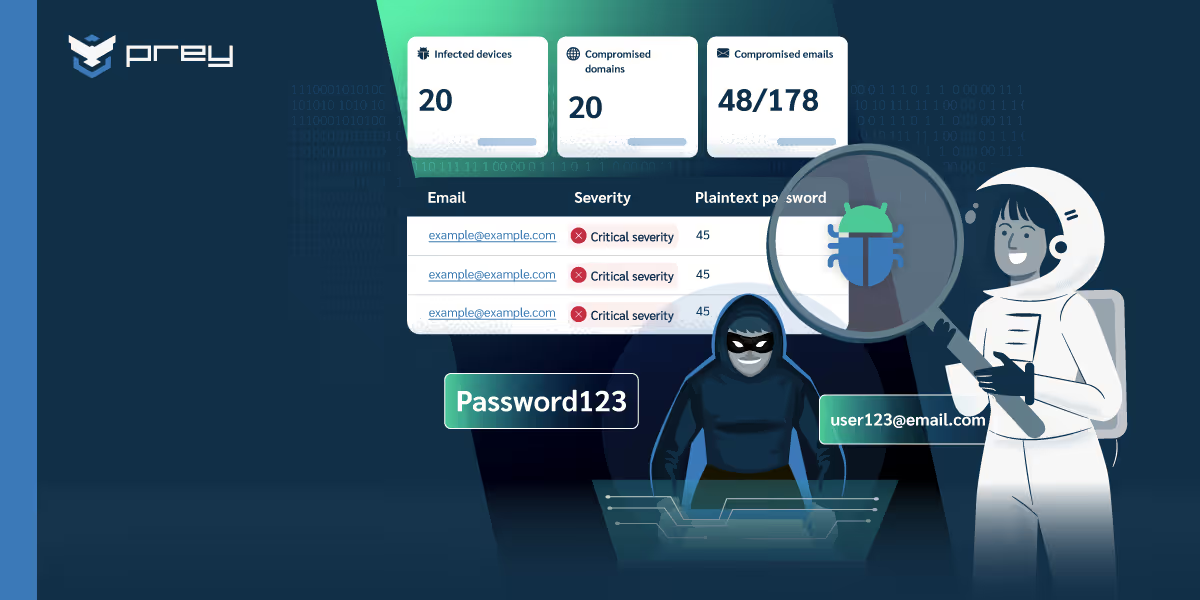
Compare the top dark web monitoring tools and services of 2026: what each scans, how alerts reach your team, and why integrated monitoring speeds response.

Explore the secrets hiding in the dark web with this essential guide for IT leaders. Learn how to improve security and fight online dangers.
Frequently asked questions
Prey’s Breach Monitoring is a 24/7 service that scans the dark web for stolen credentials and sensitive data related to your domain or email. It provides weekly updated reports with a severity score and detailed insights to help you understand risks and prevent future breaches.
A breach happens when unauthorized parties access confidential data, like login credentials, PII, or financial info, due to hacking, malware, insider threats, or accidental exposure.
Prey partners with a third-party threat intelligence provider that uses human intelligence and advanced tools to collect and validate breach data from the dark web. This data is continuously added to a central database, which Prey uses to match with your domains or emails.
We monitor emails or domains against hundreds of newly breached databases added weekly. Reports may include internal systems compromised by malware, credential leaks, keylogger infections, cloud logins, and PII exposure.
Yes. The severity report is based on actual dark web data tied to your login email or domain. It includes breach count, password reuse rate, last exposure date, and more. You can also export a full CSV with details.
Old or resolved leaks reveal patterns, weak spots, and help prevent future attacks. Cybercriminals often reuse old data for phishing, credential stuffing, or social engineering. We include breach, acquisition, and public disclosure dates for full context.
Subscriptions match Prey’s billing cycles (monthly/yearly) and can be purchased separately. Domain monitoring includes all matching emails; email monitoring is priced per address. No refunds are issued for accounts with no breach activity.
No. BM is a standalone service. While Prey protects devices, BM focuses on digital identity (email/domain). They are complementary but function independently, no Prey agent needed.
Yes! Our updated dashboard includes a searchable records table and labeling system. You can now tag breaches as "Reviewed" or "Under review" and monitor each individual record's Activity history to see revision milestones, team comments and all over mitigation efforts.
You can use our new n8n integration to automatically route all or selected Breach Monitoring data to other tools, creating automated workflows. You can use Prey's official n8n node or create a webhook to connect breach data to over 200 apps, triggering notifications and instant actions with every report update.
Free tools often detect breaches late and lack deep access to hidden criminal forums. Prey’s provider uses cybercrime analytics, security researchers, and proprietary methods to access leaked data early—often before it becomes public—offering faster, actionable insights.
A solution for MSPs is in its early design stages, and will be offered to interested customers, new and existing. Contact sales to be informed when Breach Monitoring for MSPs is available.
Find out what's already out there, before someone uses it
One work email. A domain-level summary in about 15 seconds.
Get free report- ✓ Free
- ⏱︎ Results in ~15 seconds
- ↓ Nothing to install